Are you
visiting here because you have seen the brilliant and talented fiction of John Goodman and Michael Chambers? Are you curious about how this website, which the
Charlestown Democratic Town Committee has no influence over (despite continuing
claims by Goodman and Chambers to the contrary), compares the CCA to the “final
solution”?Wednesday, May 27, 2015
Springtime for Hitler, and the CCA
Are you
visiting here because you have seen the brilliant and talented fiction of John Goodman and Michael Chambers? Are you curious about how this website, which the
Charlestown Democratic Town Committee has no influence over (despite continuing
claims by Goodman and Chambers to the contrary), compares the CCA to the “final
solution”?Saturday, October 1, 2022
DeSantis and Abbott revive racist stunt
Ron DeSantis and Greg Abbott pull from segregationists’ playbook with their anti-immigration stunts
Greta de Jong, University of Nevada, Reno
![]() |
| An undocumented immigrant from Venezuela kisses the forehead of another immigrant on the island of Martha’s Vineyard in Massachusetts. Dominic Chavez for The Washington Post via Getty Images |
Governors Greg Abbott in Texas and Ron DeSantis in Florida are following the playbook of segregationists who provided one-way bus tickets to Northern cities for Black Southerners in the 1960s.
At that time, the fight for racial equality was attracting national attention and support from many white Americans, inspiring some to join interracial Freedom Rides organized by civil rights groups to challenge segregation on interstate bus lines.
Then, as now, the message Southern racists aimed to send with their “reverse freedom rides” was, “Here, you love them so much, you take care of them.”
But these acts were more than just political stunts designed to embarrass Northern political leaders who sympathized with the civil rights movement. They were part of a broader effort by white supremacists to remove Black Americans from their communities and avoid dealing with the social consequences of centuries of racial discrimination.
Saturday, June 28, 2025
Cats among five major wins from Rhode Island’s 2025 legislative session
Rhode Island cats celebrate new ban on de-clawing
By Nancy Lavin and Christopher Shea, Rhode Island Current
The race to the legislative finish line this year was every bit as drama-filled and frenzied as expected. Restrictions on assault weapons got top billing, including on the eight-and-a-half hour marathon that marked the final day of the session, but there was plenty more to crow about and criticize during the jam-packed final weeks.Photo by Will Collette
Here are five wins you might have missed from the 2025 Rhode Island General Assembly. Stay tuned for the losses, coming Friday.
1. Shekarchi zones in on housing
House Speaker K. Joseph Shekarchi succeeded in his push to boost housing production in Rhode Island for a third consecutive year, with 10 of the 12 bills of his legislative package clearing the Senate in the final days of the session. (All 12 had already secured approval in the lower chamber.)
That includes two bills sponsored by Shekarchi: one to expand electronic permitting and another to amend the state’s building code by centralizing the responsibilities of various officials, commissions, and boards involved in building and fire code permitting.
Other bills passed include measures to allow townhouses wherever duplexes are permitted, require mixed-use zoning in every community, and promote the conversion of vacant or underused commercial buildings into housing.
“Rhode Island’s housing crisis was decades in the making and is taking a sustained effort, over the course of years, to address,” Shekarchi said in a statement Monday. “I am so appreciative of all of the partners who work with me to address our housing shortage, and this progress is the result of our collaborative efforts.”
Legislation that would have allowed development of vacant state-owned land did not make it across the finish line. Shekarchi described the bill as in need of some “fine-tuning,” pledging to work with the Senate on it again next year.
Also left hanging by the Senate was legislation that would have eased local restrictions on subdividing large parcels of land, despite having passed in the House on May 15. However, Shekarchi noted that elements of the stalled bill were addressed in one of the successful 10 bills, which sought to eliminate unnecessary red tape and delays in local land subdivision more broadly.
Senate President Valarie Lawson said while there were concerns with the bill, she intends to continue to work with Shekarchi and other lawmakers to encourage further housing development.
2. All rise for AG Neronha
Rhode Island Attorney General Peter Neronha’s skilled litigation style persuaded lawmakers to his side on a host of policy changes and added funding for his office for new hires.
Neronha initially sought 13 more staffers for his office, asking for $1.7 million to fund the hires in his fiscal 2026 budget request to Gov. Dan McKee. McKee’s proposed spending plan did not offer any of the money, or additional employees.
Neronha subsequently revised his request, asking lawmakers in the House Committee on Finance for four, rather than 13, hires, funded by settlements his office had won for the states. Lawmakers included an $848,000 allocation of state settlement money for the extra AG staffers in the final fiscal 2026 budget.
Neronha thanked lawmakers for funding the hires in a statement Tuesday.
“The people of my Office show up to work every day with one goal: improve the lives of Rhode Islanders,” Neronha said. “These four additional attorneys will share in that goal, and deliver for the residents of our state.”
Neronha scored wins on several policy changes, too, including a change to state procurement to ban “bid-rigging” by public officials. The Neronha-backed legislation taking aim at McKee’s involvement in “steering” a state education contract to the ILO Group in 2021, passed unanimously in the Senate on the final night of the session, having already secured approval by a strong majority of the House.
Lawmakers also signed on to versions of some of Neronha’s proposed remedies for the health care crisis, such as using Medicare reimbursement rates as the standard by which to hike corresponding Medicaid payments to primary care providers, and doing away with cumbersome and time-consuming pre-authorization requirements for primary care providers.
Finally, the AG’s office staved off an eleventh hour challenge by House Republicans to his authority over state settlements. GOP lawmakers unsuccessfully attempted during the House budget vote on June 17 to siphon $11 million from the AG’s fiscal 2026 funding as a quid pro quo for what they argued was an unconstitutional overstep of his authority. Neronha had already set in motion a plan to spend the $11 million state settlement from the Route 6/10 contamination lawsuit on pediatric dental care in Providence.
Speaking to reporters after the June 17 House budget vote, Shekarchi affirmed Neronha’s authority over the state settlement funds.
“If this particular settlement was unfair, the solution is to appeal that,” Shekarchi said. “What we’re doing with the money is helping underprivileged children with health care and dental care is a good thing and I will never be against that.”
3. Republicans at the ready for 2026
The most high-profile victory of the session belongs to those who supported a state ban on assault-style weapons — even if the final legislation did not go as far as some had hoped. .webp)
RI Republicans outraged at infringement
of this guy's 2nd Amendment rights
But state Republicans wasted little time turning “L” on what they say is a matter of Constitutional rights into a potential win for the party and its candidates in the 2026 election cycle.
GOP Chairman Joe Powers initiated the call to action Friday night, declaring it was actively recruiting candidates to challenge the “anti-Constitution, anti-liberty legislators” who voted to limit assault-style weapons in the state.
“We now have a clear, targeted list of every legislator who voted to betray their oath — and their time is running out,” Powers said in a statement. “To every Rhode Islander who still believes in the Constitution — we’re not going to fix this by posting memes or yelling at the TV. We fix it by running for office, knocking doors, and taking back this state seat by seat.”
His call to action has already been met with a flurry of responses — a few dozen potential candidates have reached out to the Republican Party in just the last four days, Powers said Tuesday night.
Meanwhile, Senate Minority Leader Jessica de la Cruz of North Smithfield debuted a new “Keeping the Spirit of 1776 Alive” fundraising campaign Tuesday morning, seeking support and donations to retain and boost the Republican’s 14-person presence on Smith Hill.
It’s no secret that state and local Republican party committees have struggled to recruit candidates for state and local office, diminishing their voice in a solidly blue state. Could the contested ban on assault weapons sales change the tides in their favor?
Tuesday, August 19, 2025
‘Maddening’ Proof Plastics Industry Knew Recycling Was False Solution in 1974, New Document Shows
They knew plastics recycling was a sham from the start
By Rebecca
John
This work was supported by a grant from the Fund for Investigative Journalism
This new discovery also comes against the backdrop of two
pending lawsuits alleging that U.S. plastic producers have deceived the public
about the feasibility of recycling since the 1980s.
For decades, the plastics industry has publicly advocated
recycling as a strategy for managing plastic waste. But the document, a letter written in May 1974 by Charles Brelsford
McCoy, a president and board chairman of DuPont, represents the earliest
evidence to date of a top-level industry insider admitting that many
commonly used plastic products cannot be recycled due to their complex chemical
structures.
The letter contains DuPont’s response to an invitation
asking the company to join a pilot recycling scheme in honor of the U.S.’s 1976
bicentennial celebrations. DuPont refused. The reason: recycling DuPont’s
plastic products was simply “not feasible.”
Found by DeSmog, the correspondence proves that by the early
1970s the plastic industry’s knowledge regarding the limitations of recycling
existed at the highest level, not only in the lab but also the C-suite.
The discovery also casts new light on the plastic
industry’s decades-long promotion of recycling as a viable solution to the
global plastic waste crisis.
Tuesday, February 20, 2024
One person can supervise 'swarm' of 100 unmanned autonomous vehicles
And how is this a good thing?
Oregon State University
Research involving Oregon State University has shown that a "swarm" of more than 100 autonomous ground and aerial robots can be supervised by one person without subjecting the individual to an undue workload.
The findings represent a big step toward efficiently and
economically using swarms in a range of roles from wildland firefighting to
package delivery to disaster response in urban environments.
"We don't see a lot of delivery drones yet in the
United States, but there are companies that have been deploying them in other
countries," said Julie A. Adams of the OSU College of Engineering.
Friday, April 5, 2024
Shellfishermen, DEM officials at odds over increasing nitrogen discharges in bay to feed quahogs
Can we save quahogs by releasing MORE wastewater?
By Christopher Shea, Rhode Island Current
Since last September, a joint legislative study commission has been trying to answer that question and find solutions to ensure Rhode Island’s official state shell doesn’t completely disappear from Narragansett Bay.
At its peak in 1959, nearly 5 million pounds of quahogs were harvested from Rhode Island waters, according to a March 2024 report by the Rhode Island Department of Environmental Management (DEM). Over the past three years, that number was less than 500,000 pounds.
“The findings and recommendations that are going to come from this commission are going to steer us on that path where we are going to replenish that bay,” Co-Chair Rep. Joe Solomon, a Warwick Democrat, said during the commission’s meeting Tuesday.
But department officials and the Rhode Island Shellfisherman’s Association are at odds over recommendations to achieve a final long-term solution to bring back the population of the iconic hard-shelled clam.
Shellfishermen want the state to permit additional nitrogen discharges from wastewater treatment facilities during the winter. Jim Boyd, one of four shellfishermen who serve on the commission, said doing so would help fertilize more phytoplankton that feed quahogs.
Friday, December 16, 2022
About one-third of the food Americans buy is wasted
![]() |
| Wasted food – and land, labor, chemicals, water and energy. ATU Images via Getty Images |
You saw it at Thanksgiving, and you’ll likely see it at your next holiday feast: piles of unwanted food – unfinished second helpings, underwhelming kitchen experiments and the like – all dressed up with no place to go, except the back of the refrigerator. With luck, hungry relatives will discover some of it before the inevitable green mold renders it inedible.
U.S. consumers waste a lot of food year-round – about one-third of all purchased food. That’s equivalent to 1,250 calories per person per day, or US$1,500 worth of groceries for a four-person household each year, an estimate that doesn’t include recent food price inflation. And when food goes bad, the land, labor, water, chemicals and energy that went into producing, processing, transporting, storing and preparing it are wasted too.
Friday, October 21, 2016
Will far-right crazies turn to violence if Trump doesn’t win?
Sarah Palin agrees
with Donald Trump that Democrats will somehow cheat to help Hillary Clinton win
on Election Day, and her final solution is to kill them.Thursday, January 1, 2026
New horrors planned by Trump
Shades of Nazi concentration camps
According to the Washington Post, the Trump regime plans to renovate industrial warehouses to hold more than 80,000 immigrant detainees at a time.The plan is for newly arrested detainees to be funneled —
let me remind you, with no due process, or independent magistrate or judge
checking on whether they are in fact in the United States illegally — into one
of seven large-scale warehouses holding 5,000 to 10,000 people each, where they
would be “staged” for deportation.
The large warehouses would be located close to major
logistics hubs in Virginia, Texas, Louisiana, Arizona, Georgia and Missouri.
Sixteen smaller warehouses would hold up to 1,500 people each.
America’s immigrant detention system is already the largest
in the world.
With the $45 billion Congress appropriated for locking up
immigrants, the regime has revived dormant prisons, repurposed sections of
military bases, and partnered with Republican governors to build immigrant tent
encampments in remote regions.
“We need to get better at treating this like a business,”
ICE acting director Todd M. Lyons said at a border security conference in
April, according
to the Arizona Mirror. The administration’s goal, he said, was to
deport immigrants as efficiently as Amazon moves packages: “Like Prime, but
with human beings.”
The logistical problems of converting warehouses into
detention camps are significant. Warehouses are designed for storage and
shipping of things, not people. They are often poorly ventilated and without
precise temperature controls, and they lack access to the plumbing and
sanitation systems needed to support thousands of full-time residents.
Beyond logistics is the dehumanization.
Ninety-three years ago, in March 1933, the Nazis established
their first concentration camp in what is now Dachau, Poland. Other camps were
soon established in Buchenwald and Sachsenhausen.
Initially, the Nazi’s put into these camps Communists,
Social Democrats, trade unionists, and others deemed a threat to the Nazi
regime.
After the Kristallnacht pogrom of November 9-10, 1938,
approximately 30,000 Jewish men were arrested and sent to these camps in a
mass, large-scale action that targeted them for being Jewish. The systematic
mass murder of Jews in camps designed as extermination camps did not begin
until late 1941 and early 1942, as part of the “Final Solution.”
Wednesday, September 4, 2013
Nelson Mandela’s Distinction
According to Will, Jefferson was our version of a Renaissance man, renowned as a scientist, architect, writer, politician, and political thinker. It was he, as much as anyone, who articulated the ideals of his country, awakening minds throughout the world to the possibilities of freedom and equality.
Wednesday, August 6, 2025
Talks resume to end Butler Hospital strike
Butler Hospital strikers put their time to good use
Butler Hospital healthcare workers say being on strike has not dulled their need to give back to the community. Over the last few weeks, Butler caregivers have donated over 1,400 volunteer hours at food pantries, soup kitchens, community gardens, and shoreline clean-ups. In addition, Butler workers have responded to a dangerous blood shortage across the state.
On July 21, the Rhode Island Blood Center (RIBC) declared
a blood emergency as the state’s blood supply dropped below a two-day
inventory, far below the required seven-day supply to meet hospital and patient
needs. In response, so many caregivers have stepped up that the Blood Center
set up a sponsor code on behalf of the union to participate and donate.
"We’re on day 83 of our unfair labor practice lockout -
about 12 weeks - the longest lockout/strike in hospital history in this state,”
said Ben Dagnan, a mental health worker at Butler Hospital for 23 years.
“To give you an update about where things stand, from our perspective: For
those who haven’t heard, the hospital gave us their last, best, and final offer
a couple of weeks ago, and last week, the membership voted overwhelmingly - 98%
of strikers - to
reject that last, best, and final offer. We voted to reject because there
was some movement, but it still left our lowest-paid workers behind.
“Management says that $18 an hour is enough to survive in
this state, but we all know that is not true or good enough.”
The contract Butler Hospital’s parent company, Care New
England, offered did not include dietary, housekeeping, or medical
records workers. “We have to make sure that everybody gets lifted up, and we go
back to work when everybody is lifted up,” said Dagnan.
I asked about the status of contract talks:
“Interestingly enough," said Dagnan, “on Friday, we
heard that the hospital was not interested in returning to the table, and then,
yesterday, we found out they are. We’re looking forward to meeting with them
tomorrow. We’re hoping that Mary Maran [President and COO of Butler
Hospital] and Michael Wagner [Care New England CEO] will pay a visit.
We haven’t seen them at the bargaining table once in this whole process.
They’re welcome to come, and we hope to get something done. We’ve been very
clear on what we’re looking for, so we’re ready to get back to the table and
get a solution so we can get back to work. That’s what we want to do.”
The Publics
Radio health reporter Lynn Arditi reported today that talks have indeed
resumed supervised by a federal mediator. Arditi reports that even though the 700
union members voted down Butler management’s July 11 “final offer,” the union
and management continued to have “off-the-books” meetings aimed at breaking the
impasse. - Will Collette
Tuesday, January 31, 2023
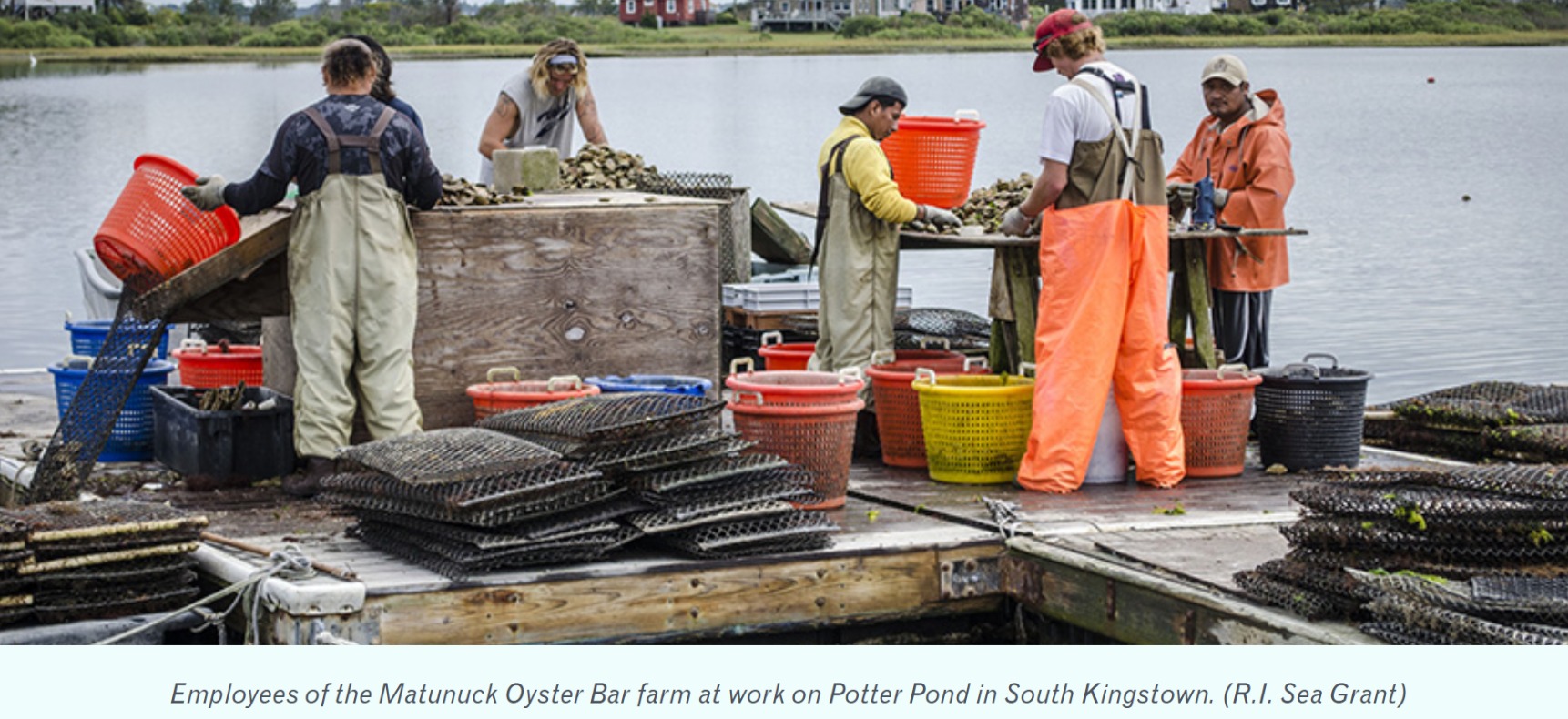
CRMC Gives New Life to Proposal to Expand Aquaculture Farm on Potter Pond.
Also hires new deputy director after political delays
By Rob
Smith / ecoRI News staff
A proposal to add 3 acres of aquaculture farms to South Kingstown’s Potter Pond gained a new lease on life this week when coastal regulators voted to send a modified version of the project back to agency staff for further study.
The Coastal Resources Management Council
(CRMC), which regulates aquaculture and other developments found along Rhode
Island’s coastline and state waters, was expected to make a final decision on
the proposal Jan. 24, but council members instead opted to seek a compromise
solution for the project by a 6-2 vote.
Jerry Sahagian, a prominent developer who has
been on the council since the 2000s, proposed reducing the size of the project
by 39%, trimming the farm’s footprint in Segar Cove from 130,000 to 80,000 square
feet, or just under 2 acres in size. Sahagian also suggested replacing the
floating gear for the farm with a different kind of aquaculture gear.
Sahagian noted agency staff recommended
approval of the project at 3 acres in size, but acknowledged the concerns of
community members who use the cove for recreation.
“This will add an additional 50 feet of buffer
which I thought would address the safety issues for water skiers,” he said.
But not all council members agreed the panel
had the power to modify the application as was proposed. Catherine Robinson
Hall, a former Rhode Island Department of Environmental Management lawyer and
coastal policies professor who was appointed to the council last year,
questioned whether the panel was being transparent and fulfilling public notice
requirements by making a major last-minute change to the project.
“It’s not a flat landscape, we’re not changing
the contours of this desk,” said Robinson Hall. “We’re talking about changing
the seabed, a very complex landscape. It’s not something we’re qualified to do
as a council, it’s something only [agency] staff can do.”
It’s the latest development in a five-year
tug-of-war between applicant Perry Raso, who owns Matunuck Oyster Bar and is
seeking to expand his Rhode Island aquaculture operations, and local residents
concerned about the impact the project may have on summer activities.
CRMC formed a special four-person subcommittee
to study the project, the Perry Raso Subcommittee, which, after dozens of hours
of public hearings, ultimately recommended the council reject the project in
a November 2021 meeting. Subcommittee members expressed repeated concerns over
the safety from conflicted uses in the cove.
The proposed farm would have three sections of
12 rows of scallop gear, with another 12 rows devoted to oyster farming. Raso
already has aquaculture farms elsewhere in Potter Pond, and approval of the new
farm would bring his total acres to 9.9, across 3% of the surface area of the
pond. CRMC regulations limit aquaculture development from occupying more than
5% of the surface area of any waterbody.
CRMC staff reportedly received 149 objections
regarding the project, noting that 79 letters came from out-of-state residents.
The objections ranged from noise to recreational fishing impacts, to visual
impacts to beach access.
“Segar Cove in Potter Pond has recreational
activities. Mr. Raso has observed that they are limited,” wrote CRMC
aquaculture coordinator David Beutel in his staff recommendation. “Any
aquaculture project in Segar Cove will affect the recreational activities. Some
of these activities may occur on the site and others adjacent to the site. Will
those activities be prohibited in Potter Pond if this site is approved? No,
those activities will still occur in Potter Pond.”
Two members of the Perry Raso Subcommittee,
Donald Gomez and Patricia Reynolds, voted to delay the council’s final decision
and send the application back to CRMC staff for additional study and a future
report.
Both council members indicated they were
against the project based on the safety concerns unearthed during the
subcommittee’s hearings.
Gomez said the council needed more information
from agency staff on any proposed changes to the project’s size or gear.
“It’s still a slippery slope,” Gomez said. “If
there’s an exchange [of gear], staff need to look at it.”
CRMC Gets New Deputy Director After Repeated Delays
By Rob Smith / ecoRI News staff
After months of delays, the state Coastal
Resources Management Council finally has a new deputy director.
Laura Miguel was picked earlier this month to
replace James Boyd, who retired last June after 22 years, for the No. 2 spot at
the agency. Miguel has more than 30 years of experience at CRMC, and previously
led its enforcement division.
The Rhode Island Department of Administration
(DOA) had placed a hold on
all personnel action requests from CRMC last August, according to records
obtained by ecoRI News last fall. The hold included three other unfilled jobs
within the agency: a new coastal policy analyst; a marine infrastructure
coordinator; and a hearing officer to adjudicate contested matters before the
CRMC.
Wednesday, May 3, 2023
Coastal Management Council Delays Final Vote on Revolution Wind to May 9
A yes vote by CRMC would be essential to permitting the offshore wind project
By Mary Lhowe / ecoRI News
contributor
![]() |
| The Revolution Wind facility is proposed for federal waters off the coast of Rhode Island and Massachusetts. (BOEM) |
Mindful of concessions and mitigation actions promised by the developers of the proposed Revolution Wind project, staff of the Coastal Resources Management Council have recommended the council vote yes on the project, thereby declaring that it conforms with the state’s coastal management plan.
But after hearing four hours of arguments from fishermen
and the public at its April 25 meeting and with several people still waiting to
comment at 10 p.m., the CRMC board took no vote, continuing the matter to its
May 9 meeting.
A yes vote, declaring that the project is consistent with
the state’s Ocean Special Area Management
Plan, would be essential to permitting the wind facility, which
still is awaiting final approval on the federal level from the Bureau of Ocean
Energy Management (BOEM).
Tuesday, November 10, 2015
Is Ben Carson nuts, or just a pathological liar?
| For more cartoons by Mike Luckovich, CLICK HERE |
Ben Carson is not having a good week. First, stories about his past, particularly those told in his book Gifted Hands, have been all but debunked — including the ultimate lie about his supposed offer of a full scholarship to West Point, as well the apparently tall tale about his supposedly violent past.
Tuesday, May 19, 2026
McKee unveils 6 picks for revamped CRMC.
Critics are underwhelmed.
By Nancy Lavin, Rhode Island Current
Three lawyers, two former state lawmakers and an entrepreneur whose business ventures include a word game app and organic salad dressings are Gov. Dan McKee’s picks for the reshaped Rhode Island Coastal Resources Management Council.
The six nominees, all men, are slated for initial confirmation hearings before the Senate Committee on Environment and Agriculture Wednesday — nearly three months after the March 1 deadline for new appointees to join the volunteer council.
McKee’s office did not respond to requests for comment Monday on the delay or on his choices of candidates. Copies of their resumes or applications were also not immediately available, nor was the total number of applications received.
McKee’s recommendation letters, submitted to the Rhode Island Senate on May 14, do not offer any details about the candidates besides their names, and, when applicable, their professional qualifications.
Requiring the volunteer panel members to have relevant work experience was a central part of the reform effort approved by state lawmakers on the final day of the 2025 legislative session. The law reduced the size of the council from 10 to seven people to fix the problem of recurring vacancies that force meetings to be canceled due to lack of quorum.
Tuesday, March 17, 2026
Revolution Wind begins delivering electricity to Rhode Island and the regional grid
We’ve got the power
By Nancy Lavin, Rhode Island Current
Rhode Island’s electric grid now includes some power from its first utility-scale offshore wind project, Revolution Wind, project developers announced Friday night.
The initial power delivery is not the final achievement: The 65-turbine project is 93% complete and not expected to hit its full 704-megawatt nameplate capacity until the second half of the year. However, the initial test of connection to the region’s electric grid marks an important benchmark, especially after two attempts by the Trump administration to block the project’s completion.
The initial power delivery appears on schedule with the prior timeline, despite two separate pauses forced by the Trump administration. The project was first put on hold in August 2025, with federal energy regulators unexpectedly demanding a review for national security concerns, despite having already completed a comprehensive review of project impacts nearly two years earlier. The stop work order was overturned by a federal judge in D.C. in September in response to one of two lawsuits filed by developers and state attorneys general.
Monday, June 9, 2014
A Gust of Nuclear-Powered Hot Air
As prospects for building new reactors grow dimmer, the industry is posing as a climate solution.
Tuesday, April 24, 2018
Do we really need more natural gas?
Sunday, January 11, 2026
R.I. has a rising tide of tiny trash on its beaches.
But it still doesn’t have a bottle bill.
By Nancy Lavin, Rhode Island Current
Cigarette butts strewn across the sand and plastic bottles bobbing in the waves are the most obvious targets of frustration about litter on Rhode Island beaches.
But the button-sized plastic and foam pieces less visible to the casual observer might be a more serious problem. More than 14,000 of these 2.5-or-smaller centimeter pieces were collected from state shorelines as part of 2025 volunteer-led efforts through the International Coastal Cleanup, according to a new report from Save the Bay.
Tiny trash came in second to cigarette butts, which claimed the dubious honor of no. 1 trash item among the 15,561 pounds of trash collected from September to November 2025. “Other plastic waste” was the third most prevalent, followed by food waste, bottle caps and plastic beverage bottles and cans.
Monday, September 28, 2026
RI Energy bills are going up, then down, then up again. What to expect starting Oct. 1.
Could be worse and probably will be next year
By Nancy Lavin, Rhode Island Current
At least, not this year.
The Oct. 1 start date for the six-month period of higher electricity pricing coincides with the beginning of a separate set of company-issued refunds, mandated under the 2022 sale of the state’s poles, wires and gas lines.
The net impact for the average residential electric customer is a monthly increase of $16.42 starting Oct. 1.
Starting in January, a second set of customer discounts from the state’s regional gas cap-and-trade program revenue will reduce bills by another $20.45 for each of the first three months of 2027.