Menu Bar

Home           Calendar           Topics          Just Charlestown          About Us

Sunday, October 3, 2021

In a rare victory, Congress passes Langevin bill to protect schools from cyber-attacks

The legislation now heads to President Biden’s desk to be signed into law 

The U.S. House of Representatives passed bipartisan legislation authored by U.S. Senators Gary Peters (D-MI), Chairman of the Homeland Security and Governmental Affairs Committee, and Rick Scott (R-FL) to enhance cybersecurity assistance to K-12 educational institutions across the country. Representative Jim Langevin (D-RI-02) led the House companion bill. 

Schools are responsible for securing a considerable amount of sensitive records related to their students and employees, including student grades, family records, medical histories, and employment information. 

The bill will help educational institutions bolster their cybersecurity protections by instructing the Cybersecurity and Infrastructure Security Agency (CISA) to examine the risks and challenges that schools face in securing their systems. 

Using their findings, CISA is charged with creating cybersecurity recommendations and other voluntary resources for schools to use when implementing their cybersecurity solutions. The bill passed the Senate in August and now heads to President Biden’s desk to be signed into law. 

“Throughout the pandemic, criminal hackers have ramped up their attacks on our nation’s schools, disrupting entire school districts and jeopardizing the personal information of students and educators alike. This legislation will help shore up our schools’ cyber defenses and protect our students and educators against those who wish them harm,” said Rep. Jim Langevin, co-chair of the Congressional Cybersecurity Caucus. 

Saturday, October 2, 2021

More guns, pandemic stress and a police legitimacy crisis created perfect conditions for homicide spike in 2020

Why we are killing each other 

Justin Nix, University of Nebraska Omaha

What role did the pandemic play in the hike in murders in 2020? 
Mark Makela/Getty Images
Homicides in the U.S. spiked by almost 30% in 2020.

That was the main takeaway from figures released on Sept. 27, 2021, by the FBI that showed almost uniform increases across America in the murder rate.

The fact that big cities, small cities, suburbs and rural areas – in both blue and red states – experienced similar increases in homicides suggests that nationwide events or trends were behind the rise.

The COVID-19 pandemic would be one obvious explanation given its pervasiveness in 2020. But as a criminologist, I know that homicide rates are affected by a number of factors. And what happened in 2020 was a confluence of events that created the perfect conditions for a spike in murders.

Aw, gee whiz

By Matt Davies, Newsday


Riddle


COVID is getting better at learning how to fly

COVID-19 virus is evolving to get better at becoming airborne, new study shows

University of Maryland

The Gesundheit II booth is used to capture exhaled breath of COVID-19 patients. SARS-CoV-2 is evolving toward more efficient aerosol generation, and loose-fitting masks provide significant but only modest source control. Until vaccination rates are very high, continued layered controls, including improved ventilation, increased filtration, UV air sanitation, and tight-fitting masks are critical to protect people in public-facing jobs and indoor spaces.

A new study finds that SARS-CoV-2 is evolving toward more efficient aerosol generation, and loose-fitting masks provide significant but only modest source control. Until vaccination rates are very high, continued layered controls, including improved ventilation, increased filtration, UV air sanitation, and tight-fitting masks are critical to protect people in public-facing jobs and indoor spaces, researchers urge.

Results of a new study led by the University of Maryland School of Public Health show that people infected with the virus that causes COVID-19 exhale infectious virus in their breath -- and those infected with the Alpha variant (the dominant strain circulating at the time this study was conducted) put 43 to 100 times more virus into the air than people infected with the original strains of the virus. 

The researchers also found that loose-fitting cloth and surgical masks reduced the amount of virus that gets into the air around infected people by about half. The study was published in Clinical Infectious Diseases.

Here comes the sun

Sunlight exposure guidelines may need to be revised

King's College London

Previously published solar exposure guidelines for optimal vitamin D synthesis based on a study of skin samples may need to be revised, according to new research published today in PNAS.

A study by researchers from King's College London, with support from the NIHR Guy's and St Thomas' Biomedical Research Centre, has tested the optimum ultraviolet radiation (UVR) wavelengths for human skin production of vitamin D in sunlight.

UVR from sunlight can cause sunburn and skin cancer, however, it is the most important source of vitamin D that is essential for healthy bone development and maintenance.

Public health advice on sunlight exposure takes both risk and benefits into account. Calculating the potential risks and benefits from sunlight exposure is not simple because the health outcomes from UVR exposure vary considerably with wavelength within the sun's UVR spectrum. 

For example, the sun's UVR contains less than 5% short wavelength UVB radiation but this is responsible for over 80% of the sunburn response. Each health outcome from solar exposure has its own unique wavelength dependency.

RI pension fund reaches all-time high: $10.42 billion

Earned over $2 billion last year

The Rhode Island pension fund continued its strong performance, growing steadily during  August 2021 with an all-time high of approximately $10.42 billion after gaining more than $2 billion in assets over the last twelve months.  

"Our Back-to-Basics Investment strategy is helping is to support economic opportunity and financial stability in Rhode Island by strengthening the pension fund that thousands of Rhode Island families rely on for retirement security," said Rhode Island General Treasurer Seth Magaziner.   

During the month of August 2021, the pension fund returned 1.26%. The pension fund continues to outperform its long-term actuarial target return, achieving annualized returns of 20.31%, 11.29%, and 10.63% for the trailing 1-year, 3-year, and 5-year periods. 

A traditional 60% stock / 40% bond portfolio would have returned only 16.55%, 11.13%, 9.98% over the same periods, respectively.  

Additional information about the Rhode Island pension system, including the 'Back to Basics' investment strategy and performance, can be found online as part of Treasurer  Magaziner's "Transparent Treasury" initiative at investments.treasury.ri.gov.  

All performance is reported on a "net of fees" basis. 

Friday, October 1, 2021

Book Review: An Emergency Room Doctor’s View of the Covid Crisis

Welcome to hell

By Jaime Herndon

In late winter 2020, when the full gravity of Covid-19 was only starting to come to light in New York City, journalist Dan Koeppel sent a text to his cousin, Robert Meyer, an emergency room doctor at the Montefiore Medical Center in the Bronx.

"How are you doing? I’m worried for you."

"Hanging by a thread," Rob replied.

"Are you seeing a lot of cases?"

"Yes."

"On a scale of 1 to 10, where do you think you are?"

The answer arrived 10 minutes later: “100.” After that, Koeppel encouraged Meyer to text, email, and call him about what was going on, as a coping mechanism. 

It eventually became a diary of sorts, and that, combined with interviews with Meyer's colleagues, became "Every Minute Is a Day: A Doctor, an Emergency Room, and a City Under Siege."

Montefiore is affiliated with the neighboring Albert Einstein College of Medicine and is home to the second-largest medical residency program in the United States, after the Mayo Clinic. 

It is part of a sprawling system with many buildings, labs, classrooms, and even housing for residents. Montefiore is the largest employer in the Bronx, “one of the poorest, least healthy urban counties in the U.S.,” as the book points out. The area is also filled with nursing homes. All of these factors came together during the pandemic to flood the hospital’s ER.

Meyer’s nearly 25 years at Montefiore had given him a wealth of experience, and he and his colleagues were prepared for everything. Everything except Covid-19. But in fairness, no hospital was ready.

As early as January, doctors at Montefiore had started to hear about patients with symptoms similar to the U.S.’s first confirmed patient, who had returned from Wuhan to his home in Washington state on Jan. 15 and tested positive for Covid-19 a few days later. 

Around the same time, Meyer reports hearing stories of New Yorkers coming to the hospital complaining of symptoms like fever, cough, and fatigue and being treated for the flu and released. 

One doctor told him that they had sent information about a suspected case to the Centers for Disease Control and Prevention, but there was no response. Later on, Meyer muses: "Were they Covid? Later studies would say probably, but at the time Covid-19 wasn’t even on our radar."

By early March, positive Covid-19 cases were detected in New York and the number of patients admitted to the hospital with Covid-19 started building slowly — and then exponentially. Because of its location near many nursing homes, the Montefiore ER saw many of the city’s sickest patients. 

Meyer and Koeppel are not shy about pointing out the systemic factors that made everything about the pandemic worse for this hospital. "Life in the Bronx is hard and resources are scarce," they write. "All those comorbidities that have led to all those Covid fatalities in poor communities around the world were preventable in a way that Covid itself wasn’t.”

Through Meyer’s eyes, the authors paint a gruesome scene of the early days of the pandemic: ERs packed with stretchers, not enough ventilators, and soon, not enough personal protective equipment. The speed with which the virus took hold was unexpected, even for medical professionals, which led to overcrowding and the turning away of patients. 

Martyrs' Day?

For more cartoons by Jen Sorenson, CLICK HERE.


Happy birthday, Jimmy!


How we pay for it


Landscape Architecture series underway

Explores the meaning of history and culture in landscape architecture

Tony LaRoche

The University of Rhode Island’s 29th annual Landscape Architecture Lecture Series opened last week with a presentation by Patricia O’Donnell, a preservation landscape architect and urban planner whose firm has worked on such iconic projects as the National Mall and the Woodstock Festival Site as well as advancing the valued landscape heritage of diverse cultures.

The fall lectures will explore the meaning of history and culture in the works of professional landscape architects, said William Green, professor of landscape architecture and series organizer. 

The series returns to an in-person format this semester with lectures Thursdays at 7 p.m. in the Ernest Mario Auditorium (room 170) in Avedesian Hall, 7 Greenhouse Road, on the Kingston Campus. The lectures are free and open to the public. All attendees must wear a face covering.

O’Donnell, founder of Heritage Landscapes LLC in Charlotte, Vermont, will discuss “Cultural Landscapes for Planetary Justice – How Does Heritage Contribute” in her virtual talk, which will be broadcast in the Earnest Mario Auditorium, followed by a question-and-answer session. (Speakers for the remainder of the fall schedule are expected to be in person.)

Since its start in 1987, Heritage Landscapes has completed more than 500 commissions that foster preservation and promote economic, environmental and societal sustainability for valued public spaces. The company was honored with the American Society of Landscape Architects’ prestigious Firm Award in 2019 for 32 years of preservation work.

Cat bacteria treats mouse skin infection, may help you and your pets as well

Beneficial kitty bacteria may actually become a treatment for humans

By Nicole Mlynaryk, Bigelow Science Communication Fellow, University of California - San Diego

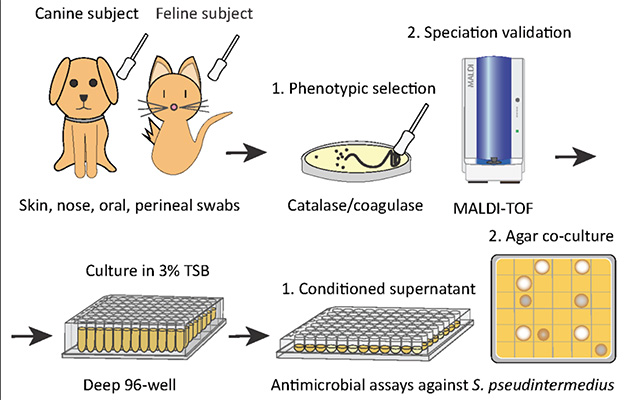
To identify candidates for a new bacteriotherapy against skin infection, researchers first screened various bacteria from dogs and cats and co-cultured them with S. pseudintermedius in liquid and agar antimicrobial assays.

Researchers at University of California San Diego School of Medicine used bacteria found on healthy cats to successfully treat a skin infection on mice. These bacteria may serve as the basis for new therapeutics against severe skin infections in humans, dogs and cats.

The study, published in eLife on October 19, 2021, was led by Richard L. Gallo, MD, PhD, Distinguished Professor and chair of the Department of Dermatology at UC San Diego School of Medicine, whose team specializes in using bacteria and their products to treat illnesses -- an approach known as "bacteriotherapy."

Skin is colonized by hundreds of bacterial species that play important roles in skin health, immunity and fighting infection. All species need to maintain a diverse balance of healthy skin bacteria to fight potential pathogens.

"Our health absolutely depends on these 'good' bacteria," said Gallo. "They rely on our healthy skin to live, and in return some of them protect us from 'bad' bacteria. But if we get sick, 'bad' bacteria can take advantage of our weakened defenses and cause infection."

Worden Pond: Toxic to the touch

RIDOH and DEM Recommend Avoiding Contact with Worden Pond

The Rhode Island Department of Health (RIDOH) and the Rhode Island Department of Environmental Management (DEM) are advising people to avoid contact with Worden Pond in South Kingstown due to a blue-green algae (or cyanobacteria) bloom.

Blue-green algae can produce toxins that can harm humans and animals.

 A very high level of a toxin called microcystin was detected in a water sample taken from the shoreline on Woodsia Trail. 

Recent consecutive surveys and sample analyses at Brickyard Pond in Barrington confirmed that blue-green algae has been at acceptably low levels, and that cyanotoxin is not present in detectable concentrations. These findings meet state guidelines to support lifting the advisory.  

People should be careful not to ingest water or eat fish from Worden Pond. All recreation, including fishing, boating, and kayaking, should be avoided. Animals who may ingest the water are especially at risk from exposure to the algal toxins, so owners should not allow pets to drink or swim in the lake. The advisory will remain in effect until further notice. 

Skin contact with water containing blue-green algae commonly causes irritation of the skin, nose, eyes, and/or throat. Common health effects associated with ingesting water containing algal toxins include stomach-ache, diarrhea, vomiting, and nausea. Rarer health effects include dizziness, headache, fever, liver damage, and nervous system damage. Young children and pets are at a particular risk for health effects associated with algal toxins. People who have had contact with pond waters and experience those symptoms should contact their healthcare provider. 

Only South County Hospital and Landmark in Woonsocket have penalty-free records with Medicare

Look Up Your Hospital: Is It Being Penalized By Medicare?


Under programs set up by the Affordable Care Act, the federal government cuts payments to hospitals that have high rates of readmissions and those with the highest numbers of infections and patient injuries. 

For the readmission penalties, Medicare cuts as much as 3 percent for each patient, although the average is generally much lower. 

The patient safety penalties cost hospitals 1 percent of Medicare payments over the federal fiscal year, which runs from October through September. Maryland hospitals are exempted from penalties because that state has a separate payment arrangement with Medicare.

Click HERE for the original article with look-up tools for each type of penalty. You can search by hospital name or location, look at all hospitals in a particular state and sort penalties by year.

Here is the record of hospitals in Rhode Island:

Subscribe to KHN's free Morning Briefing.