 |
| For more cartoons by Tom Tomorrow, CLICK HERE |
Friday, August 4, 2023
Another charity scam by the uber-wealthy
How the Ultrawealthy Use Private Foundations to Bank Millions in Tax Deductions While Giving the Public Little in Return
By Jeff Ernsthausen for ProPublica
 |
| Nolan Pelletier, special to ProPublica |
A massive trove of tax information obtained by ProPublica, covering thousands of America’s wealthiest individuals, reveals what’s inside the billionaires’ bag of tricks for minimizing their personal tax bills — sometimes to nothing.
 |
| Carolands estate (Wikipedia) |
I was sitting just outside this splendor, idling in my rented Toyota Corolla, on a clear day last winter. Like the other people in the line of cars, I was about to enjoy a rare treat. Carolands is an architectural landmark, but it’s open only two hours a week. Would-be visitors apply a month in advance, hoping to win a lottery for tickets. Like most lotteries, this one has long odds.
I had applied unsuccessfully for the three tours scheduled for February. Finally, I resorted to my journalist’s privilege: I emailed and called the director of the foundation that owns the estate, explaining that I was a reporter planning to be in the area for a few days. Could she help? Eventually, she called back and offered me a place on a tour.
It wasn’t supposed to be this difficult. When billionaire Charles Johnson sought a tax break in 2013 for donating his mansion to his private foundation, the organization assured the Internal Revenue Service and state officials that the public would be welcome.
“The Foundation will fulfill its charitable and educational purpose by opening the Carolands Estate to the public,” it stated in its application for tax-exempt status, which included a pamphlet for a self-guided tour. The foundation later told a California tax regulator that the estate was open to the public every weekday from 9-5.
There was a lot of money at stake. Johnson, a Republican megadonor and part owner of the San Francisco Giants, had gotten an appraisal valuing the property at $130 million, a price higher than any publicly reported home sale in the U.S. up to that time, and five times the $26 million he and his wife, Ann, had reportedly paid 14 years earlier to buy and restore what then was a dilapidated property.
The plan worked. The IRS granted the foundation tax-exempt status. That allowed the Johnsons to collect more than $38 million in tax savings from the estate over five years, confidential tax records show.
But the Johnsons never opened Carolands to the public for 40 hours a week. Instead, the foundation bestows tickets on a few dozen lottery winners, who receive two-hour tours, led by docents, most Wednesdays at 1 p.m. Self-guided tours, like the ones described in the attachments to Johnson’s IRS application, are not offered.


Bye, bye summer flounder, lobster and other favorites
Effects of “unprecedented” marine heat waves may be irreversible

July marked Earth’s hottest temperatures ever, and heat
waves are currently affecting over 44% of ocean area, making the current marine
heat wave the most widespread ever recorded. Scientists at the National Oceanic
and Atmospheric Administration (NOAA) expect that number to rise to over 50% by this
fall. Usually, about 10% of the world’s oceans experience a heatwave at any
given time.
The levels of marine heat waves this year are
“unprecedented,” said Dillon Amaya, a scientist who studies climate extremes at
the NOAA.
The marine heat wave could lead to a redistribution of
ocean species that may then also destabilize additional ecosystems, according
to Jenn Caselle, a research biologist at the University of California, Santa
Barbara’s Marine Science Institute.
“These marine communities that are reshuffling right now could stay in those reshuffled states and become our new normal,” said Caselle.
SouthCoast Wind files court challenge to R.I. regulators
Wind Farm developer challenges state roadblocks
By Nancy Lavin, Rhode Island Current

In a petition with Rhode Island Supreme Court on July 28, SouthCoast Wind Energy LLC contends that the Rhode Island Energy Facility Siting Board decision “is contrary to law and should be vacated.”
Last month, the board unanimously agreed to halt its review of the transmission lines for the project until the developer secures new agreements guaranteeing the project’s financing.
The 149-turbine wind farm, planned off the coast of Massachusetts, was originally intended to bring 1,200 megawatts of power to the Bay State. While centered in Massachusetts, the proposal also needed the signoff from Rhode Island regulators on plans to run a underwater transmission line from the wind farm up the Sakonnet River, over Portsmouth and out Mount Hope Bay to reach land in Somerset’s Brayton Point.
But after SouthCoast opted to renege on its existing power purchase agreements with Massachusetts utility companies in the hopes of getting a better deal, Rhode Island regulators agreed it was a waste of time and resources to continue their review when the project’s future is still uncertain.
Thursday, August 3, 2023
Feeling really guilty about actually using real quotes
Thom Cahir responds to a Letter from Bonnie Van Slyke
By Thom Cahir
 |
| CCA Sisterhood: Ruth Platner (left) calls the CCA shots and Bonnie Van Slyke (right) tries to explain them |
Guilty as charged! I did indeed
reference the Hayes case and Mr. Vanover’s own words about being “exhausted,”
and how he changed his vote, according to Ms. Van Slyke’s letter of July 26
(“Personal attack on Vanover was dishonest”). However, I’m not sure how
truthfully repeating someone’s words and multiple cases of the Zoning Board
trigger Ms. Van Slyke to such a degree.
Maybe Ms. Van Slyke was more upset that I
added that the Zoning Board hadn’t been guilty of running afoul of abusing the
process previously. However, she failed to mention it in her letter because it
didn’t fit her narrative.
In the 2019 Bruce Gardner and Charles A. Sweet
Revocable Trust case, Judge Taft-Carter wrote,
“The decision of the Zoning Board of Review is affected by clear error of law, clearly erroneous in light of the evidence of this case, arbitrary and capricious, and characterized by abuse or unwarranted exercise of discretion.”
Refer to WC-2019--0327 for full details.
Ms. Van Slyke and her Charlestown Citizens
Alliance cohorts must be feeling particularly minimized and desperate right
now.
Why would they want to defend Mr. Vanover when
he may have escaped being cited for his words, but the appearance led to this
footnote in a filing:
“Member Vanover could be praised for his candor. However, the message it sends to applicants and opponents appearing before the Zoning Board is stark: if you think your position is going down to defeat, keep the hearing going as long as possible, and maybe a board member will simply give up. That is not how zoning decisions should be made.”
 |
| Cliff Vanover, very exhausted perhaps from Lyme disease, was described by Rhode Island Monthly as "a veritable tick magnet. The Town Council has relieved Cliff of that onerous duty. |
It must be frustrating to have wielded power so ruthlessly and for so long with so little transparency and with no one to fact-check the gaslighting.
I plead guilty to being Ms. Van Slyke’s worst
nightmare since coming to town seven years ago, having experience as a
political organizer and messaging expert.
Let’s face it, Ms. Van Slyke has lost
standing in the town and is on video at a recent council meeting stating, “I
don’t mean to be argumentative … well I do mean to argue.” If writing letters
to The Sun is her only outlet, I’ll be here to fact-check her. I worked in a
newsroom for years and still freelance for numerous outlets, so I’ll just
consider it, my guilty pleasure.


Hail to the weekend warriors
People who exercise only on the weekend have similar heart-health benefits as those who exercise throughout the week
Exercise is good for your overall health and your heart in particular. Guidelines recommend that we should be doing 150 minutes of moderate-to-vigorous activity a week. But does it matter when you do this exercise? 
For maximum benefit, you have to break a sweat.
Diego Cervo/Shutterstock
Should you spread it out in the week or does it lose some of the benefit if you cram it in at the weekend?
A new study analysing data from the UK Biobank has attempted to answer this very question. Around 90,000 healthy, middle-aged people wore wrist bands (accelerometers) that tracked their activity. It recorded their activity levels for a week with particular attention to moderate-to-vigorous activity (more on that later).
The researchers found that in the six years after the accelerometer assessment, people who did regular moderate-to-vigorous activity had less stroke, heart attack, heart failure and atrial fibrillation (an irregular heart rhythm) compared with sedentary people.
The novel finding of this study was that there was no difference in outcomes in people who did more than half of their activity at the weekend compared with those who spread it out across the week. It didn’t matter when it was done, moderate-vigorous physical activity was associated with improved heart health.
The PFAS hits just keep on coming
New worries about risks PFAS and other chemicals pose for pregnancies

The researchers said their findings add to
a growing body of evidence showing that many chemicals people are routinely
exposed to are leading to subtle, but harmful, changes in health.
Criminal law expert explains new charge based on Trump's role in Jan. 6 insurrection
Using ‘dishonesty, fraud and deceit’ to cling to power
Gabriel J. Chin, University of California, Davis
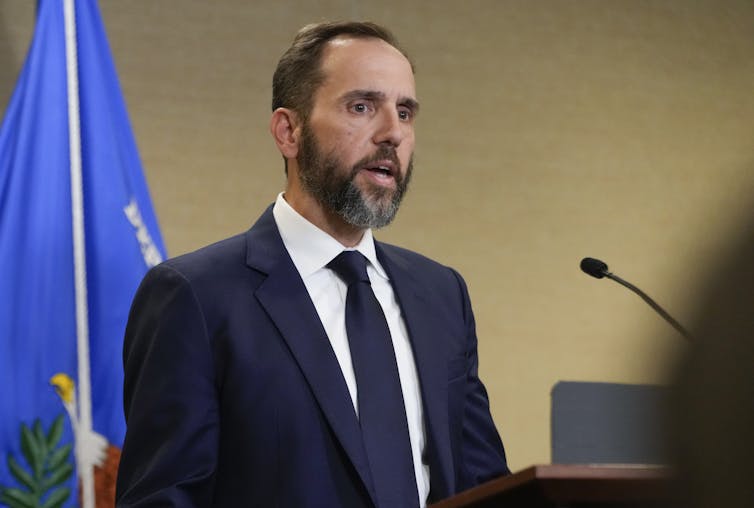 |
| Special Counsel Jack Smith announces the second federal indictment of Donald Trump on Aug. 1, 2023. AP Photo/Jacquelyn Martin |
It’s because these are the first federal charges alleging a former president effectively attempted a particular kind of coup, called an auto-coup, in which he attempted to keep himself in power by illegal means.
The indictment lists four felony charges. All of them rely on the same facts and boil down to the same set of five allegations, many of which have been previously reported.
All of the charges rest on the claim that Trump and his co-conspirators knew the former president lost the 2020 election, and that his claims of fraud and voting irregularity made before and on Jan. 6, 2021 were unfounded.
Three counts in this new indictment allege conspiracies: There is conspiracy to defraud the government; to obstruct an official proceeding – in this case, counting the electoral votes on Jan. 6, 2021; and against the rights of the voters to cast ballots and have them fairly and honestly counted.
The remaining count alleges obstruction of an official proceeding – namely, tallying the electoral vote. The document states that Trump allegedly had the help of six co-conspirators, including four lawyers, a Justice Department official and a political consultant.
None of them are charged in the indictment, and they are identified by number, not name. This could mean one or more of these people are cooperating with the Justice Department, but not necessarily.
The indictment charges that all of Trump’s many claims of election irregularities “were false, and the Defendant knew that they were false.”
I am a scholar of criminal law and procedure. While Trump is facing multiple other charges, this indictment contains the most serious charges he has faced thus far.
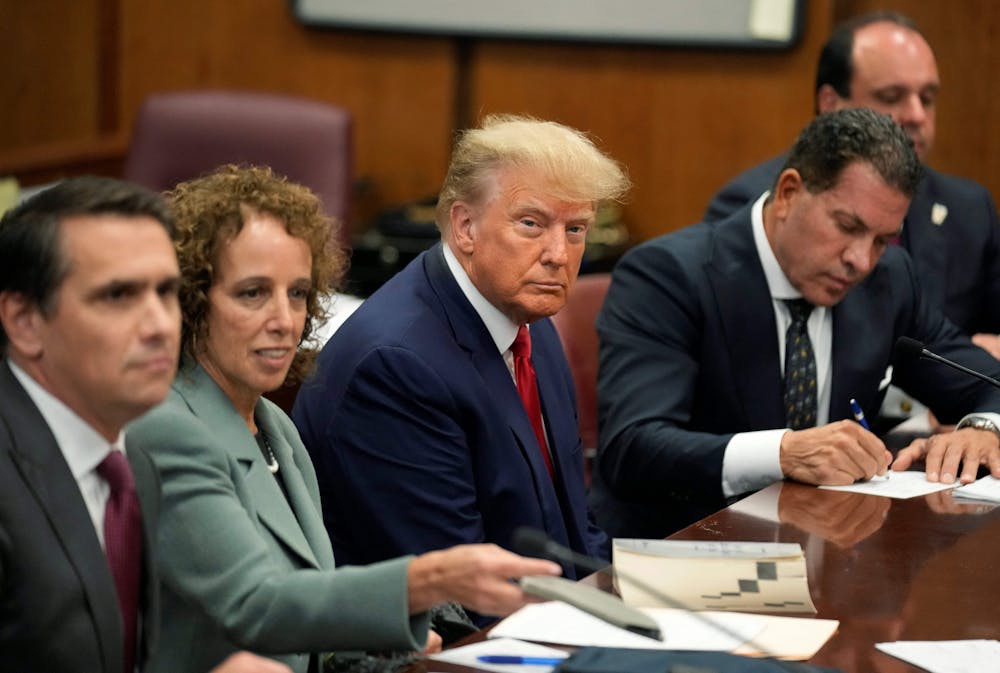 |
| Former President Donald Trump with his attorneys inside the courtroom during his arraignment at the Manhattan Criminal Court on April 4, 2023. Seth Wenig/POOL/AFP via Getty Images |
And the Justice Department has charged him in Florida with illegally keeping national security documents, but there is no allegation they were disclosed to foreign agents or represented much more than souvenirs.
This indictment, by contrast, alleges that Trump knowingly worked to hold on to an office he knew he was not entitled to.
Wednesday, August 2, 2023
Most Serious Charges Against Trump Yet Won’t Hurt Him with GOP Voters
Maybe Trump COULD get away with shooting someone in the middle of Fifth Avenue.
ROBERT REICH in Robertreich.Substack.Com

These are the most serious charges against
Trump yet, but the reality is that these charges will only boost Trump in the
Republican primary.
In March, several weeks before the first
indictment, Trump had just 43% of the vote in Republican polling, according to
a RealClearPolitics average. But a day after he was charged in a hush money
scheme to an adult film actress, his numbers had jumped to 50%.
Two months later, he was indicted for
mishandling classified documents. His polling average jumped again. By July 18,
when a federal judge clarified that Trump had “raped” writer E.
Jean Carroll, Trump’s approval had risen to 54% in the
RealClearPolitics national polling average—a 10-point climb during the spring
and summer.
So today’s long-expected Justice Department
indictment of Trump for trying to overturn the last presidential election is
likely to boost his favorable rating into the polling stratosphere as far as
the Republican nomination is concerned.
Each indictment and civil verdict against
Trump provides even more ammunition for Trump in his campaign against the
so-called “Deep State.” Each further entrenches his campaign in a singular
narrative focusing on him—placing Trump at the center of a national conspiracy.
This dynamic makes it all but impossible
for any of his rivals to criticize him. DeSantis and most of Trump’s opponents
have embraced the Trump-stoked view that nearly any effort by a Democratic
administration to pursue justice against Trump is de facto illegitimate. Siding
with Jack Smith against Trump has become a litmus test that is little different
from choosing the wrong side on abortion.
The Trump campaign’s current strategy is to
attack rivals (mostly Ron
DeSantis) for any hint they might be siding with prosecutors over
Trump.
The dynamic also ties the Republican Party
ever tighter to Trump’s self-referential conspiratorial narrative.
But each indictment and civil verdict has
given the rest of America further confirmation of how dangerous and loathsome
Donald Trump really is, and how far the Republican Party has gone in rejecting
the rule of law.
There will not be enough time in the
general election to alter this dynamic. It will likely contribute to Democratic
sweeps of the presidency, Congress, and most state contests.
It could also put the current GOP into a
death spiral—resulting in a purge of its Trump-dependent lawmakers and
candidates. This may be the only way the Republican Party can begin to rebuild
itself.
Tuesday’s indictment begins a reassertion
of the rule of law in America. We are deeply indebted to Special Counsel Jack
Smith and his staff for their care, integrity, and commitment to the Constitution.
© 2021 robertreich.substack.com
ROBERT REICH is the Chancellor's Professor of Public Policy
at the University of California, Berkeley, and a senior fellow at the Blum
Center for Developing Economies. He served as secretary of labor in the Clinton
administration, for which Time magazine named him one of the 10 most effective
cabinet secretaries of the twentieth century. His book include:
"Aftershock" (2011), "The Work of Nations" (1992),
"Beyond Outrage" (2012) and, "Saving Capitalism" (2016). He
is also a founding editor of The American Prospect magazine, former chairman of
Common Cause, a member of the American Academy of Arts and Sciences, and
co-creator of the award-winning documentary, "Inequality For All."
Reich's newest book is "The Common Good" (2019). He's co-creator of
the Netflix original documentary "Saving Capitalism," which is
streaming now.


Neronha wants shoreline access lawsuit thrown out
Says the beach front property owners' lawsuit is fatally flawed
By Nancy Lavin, Rhode Island Current

So said Attorney General Peter Neronha, whose office filed a motion in U.S. District Court for the District of Rhode Island on Monday seeking to dismiss the lawsuit.
The new law, signed by Gov. Dan McKee in June, attempted to clarify a decades long dispute over where to draw the line in the sand, allowing public access to the beach anywhere 10 feet landward from the high tide or “wrack” line.
Weeks later, a group of shoreline property owners known as the Rhode Island Association of Coastal Taxpayers sued Neronha and other state agencies, contending the law amounted to an unconstitutional “taking” of their property and asking for a judge to immediately stop them from enforcing the law.
Neronha’s office countered in the 58-page filing that the taxpayers group failed to identify any individual members who have been harmed by the state law clarifying public beach access. Even David Welch, president of the taxpayers group, doesn’t qualify because the Charlestown beachfront home is owned by a limited liability company, not Welch himself, Neronha’s office said.
Subscribe to:
Posts (Atom)