Menu Bar

Home           Calendar           Topics          Just Charlestown          About Us

Tuesday, January 30, 2024

Ignore the CCA propaganda on "accessory dwelling units" (ADU)

Charlestown is NOT ending single-family zoning despite what the CCA says

By Will Collette

How the CCA sees ADUs
You’d have to be living under a rock not to be aware that there is an ongoing affordable housing crisis suffocating virtually every community in America.

Then, of course, there is the Charlestown Citizens Alliance (CCA), dba Planning Commissar Ruth Platner and former CCA-sponsored Town Council member Bonnita Van Slyke, hunkering down in the CCA’s fabled secret clubhouse to regurgitate furballs of hyperbolic nonsense.

Their latest litterbox conclusion being that “Single Family Zoning no longer exists in Charlestown” so everyone needs to head to their fallout shelters.

A more realistic example of an ADU
(RI Home Store)
Our state capitol building’s famed marble dome notwithstanding, even Rhode Island’s body politic finally awakened to the basic dollars-and-sense reality of affordable housing, adjusting state law to allow for expanded, simplified family housing termed "accessory dwelling units," often referred to in the past as "mother-in-law apartments." 

If you look below (⏬) at current town policy, adjusted to comply with state law, these are labeled "ADU #1."

The CCA is most concerned about "ADU #2," which are units that may be detached from the main house and could theoretically be occupied by someone who is not a disabled/elderly family member of the property owner. Charlestown has had something similar on the books called I-RADUs – I’ll explain what those are shortly.

Accessory dwelling units are not new to Charlestown

Actually, the CCA has ALWAYS been against the concept of accessory dwelling units (ADUs). It was one of the very first issues covered in Progressive Charlestown, starting in February 2011 just one month after PC's launch.

In 2011, as now, Ruth Platner talked about ADUs as a major step on Charlestown's road to perdition, claiming - without evidence - that ADUs for family members were being rented to outsiders.

Despite that, Platner proposed two ordinances, one called AFDUs for close family members and another new category called I-RADUs, standing for "Income-Restricted Accessory Dwelling Unit." 

Platner’s plucky planners had worked on these ordinances for five years, starting in 2006.

In theory, these ordinances allowed just about every residential property in Charlestown to build either an AFDU or I-RADU, though when you get into the details, it's pretty clear Ruthie's ordinances were designed to fail.

In fact, Platner told the council that neither ordinance was likely to work or be enforceable. Nonetheless, the 2011 CCA-controlled Town Council enacted them anyway. 

And fail they did. According to our veteran Building and Zoning Officer Joe Warner, Charlestown has never issued a permit for an I-RADU and only 2 or 3 AFDUs get built every year. That’s over a period of 12 years. Has anyone seen any negative effects from these units?

Now in 2024, the CCA is again condemning the new ADU ordinance claiming it will open the floodgates for all kinds of people, including (clutch your pearls) "People From Providence."

Except the only hard evidence we have is Charlestown’s actual experience with I-RADUs and AFDUs between 2011-2023. The 2011 ordinances didn't cause the end of the world as we know it as Platner and CCA broken-spoke Bonnita Van Slyke would have you believe.

ADUs can be a relatively simple way for coastal and rural towns like Charlestown to generate affordable housing with low impact and low cost. But count on the CCA to find a line of attack.

A neat rhetorical trick

There’s a device in logic called “reductio ad absurdum” where you destroy any proposal by taking it to the ultimate extreme, suggesting that if something CAN happen, it WILL happen.

Thus, if every residential property owner can build an ADU, everyone WILL build an ADU. But ask yourself: how likely is it that YOU will build an ADU? Twelve years of experience tells us the CCA doomsday vision ain’t gonna happen.

The CCA uses reductio ad absurdum on every one of their imaginary threats, claiming that whatever the threat, it will be catastrophic and only the CCA can protect Charlestown. Each of the CCA’s claims fall apart when you look at the facts and probabilities and apply a little common sense.

I am sick of the exodus of Charlestown kids who must leave town because they can't afford housing (ex-CCA Council member Cody Clarkin is a prime example). 

Same for older residents who need to downsize but can't afford to buy new housing. They must instead seek help from friends or leave town. Does that sound familiar, Bonnie?

The CCA had no affordable housing proposals of its own during its decade of control over Charlestown, but you can always count on them to come up with lots of objections larded with lies and exaggerations for ideas proposed by others. 

To read the Rhode Island General Laws regarding accessory dwelling units, CLICK HERE and scroll down to §45-24-72 through 76.

It's NEVER enough

Jose Arroyo 


"Stable genius" sharpens his message

Plastic Pieces Overtake Cigarette Butts as Ocean State’s Top Beach Debris

Plastic waste bits never go away - they just get smaller

By Staff / ecoRI News

Credit: J. Lynch/NIST
For the first time in the history of Rhode Island’s participation in the International Coastal Cleanup program, cigarette butts were not the item most collected by volunteer participants. 

Instead, small plastic and foam pieces — those pulverized bits that accumulate in wrack lines — took the lead, according to Save The Bay’s recently released 2023 International Coastal Cleanup Report.

New Research Reveals a Clear Winner for Muscle Growth

Meat vs. Plant

By MAASTRICHT UNIVERSITY MEDICAL CENTER 

Extensive studies have demonstrated that the intake of dietary protein plays a crucial role in promoting muscle protein synthesis, a key element in the development and upkeep of skeletal muscle mass. 

Recent findings suggest a significant difference between animal-based and plant-based protein sources regarding their effectiveness in stimulating muscle growth and maintenance. 

This disparity is largely attributed to variations in the protein quantity and quality, as well as the differing levels of essential amino acids (EAA) present in these food sources.

How real is McKee's promise to raise Rhode Islanders' incomes by $20,000

McKee set a bold goal to raise per capita income but didn't give details

By Nancy Lavin, Rhode Island Current

Photo by Steve Ahlquist
It’s hard to think of anyone in Rhode Island who wouldn’t welcome a $20,000 raise.

Which is exactly why Gov. Dan McKee’s bold goal to increase the average, per-person income by at least $20,000 by the end of the decade grabbed the attention of news outlets, lawmakers and policy analysts. 

Rhode Island’s per-capita income ranks second-lowest among New England states, besting only Maine and just below Vermont, according to quarterly estimates from the U.S. Bureau of Economic Analysis. A $20,000 increase would put Rhode Island nearly on-par with Massachusetts and Connecticut.

But since unveiling his headline-making declaration in the annual State of the State on Jan. 16, McKee’s office has offered zero explanation about what his vision entails, or how it will be achieved.

Instead, the administration promised a plan by early May. The absence of even basic details like whether the increase will account for inflation — or what the earnings estimate being used as a baseline is  — has left some policy analysts skeptical that McKee’s lofty vision will make a difference in residents’ wallets and savings accounts.

Monday, January 29, 2024

Big Trump Secret About to be Revealed

What happens when he has to come up with real money?

By DAVID CAY JOHNSTON

By Pia Guerra
The $83.3 million defamation judgment that writer E. Jean Carroll won Friday against Donald Trump will soon reveal the depth of his finances, long shrouded in smoke and mirrors, disclaimers that his financial statements are not to be trusted, and outright fabrications about his income and wealth.

The secret: does Trump have the money to pay Carroll?

Trump says he’ll appeal. He has few grounds to challenge the federal court judgment. But if Trump does appeal, it will open the curtain on his murky finances, where inflated valuations and concealed obligations are common.

Trump testified almost a year ago that he was sitting on $400 million of cash. Be skeptical. Don’t discount the prospect that Donald conflated his personal money with cash from his MAGA fundraising operations, which by law cannot be used to pay Carroll.

Appealing will require Trump to either deposit the entire judgment amount with the court or obtain a bond covering 20% of the judgment, close to $17 million.

If you were in the financial business, would you loan any money to Trump? What if he offered to pay a fat fee upfront? A high-interest rate? What real estate would you take as collateral to back the bond, knowing that if the appeal fails, Trump will fight to keep you from collecting?

As early as this week, Trump expects a Manhattan judge to impose a fine of more than $300 million for persistent financial fraud.

Naked Claim

Even if Trump had $400 million cash a year ago, an unverified claim, he has faced enormous legal and other bills since then. At the same time, his golf courses in Ireland and Scotland continued losing money, public records in London show.

The Carroll case and the expected New York State civil judgment for persistent fraud would consume 96% of the cash he claimed without proof.

Suppose Trump can’t financially qualify to pursue an appeal. In that case, Carroll can enforce judgment, seizing cash in bank accounts and pitting liens on properties such as the portion of Trump Tower that Trump still owns and Mar-a-Lago in Florida. That would take time and cost Trump a small fortune in legal fees—he has a history of stiffing his lawyers—to delay paying Carroll. Meanwhile, interest costs will add to the $83.3 million obligation.

And the kids paid the price

By Matt Davies

This vaccine STOPS cancer


$350,000 in new funding awarded for clean-up of Shannock Village

New Round of Brownfields Grant Awards

The state announced the award of $2.525 million in reimbursable grants under the Brownfields Remediation and Economic Development Fund for the cleanup and redevelopment of contaminated properties, known as brownfields, across Rhode Island. 

0 projects across five cities and towns will receive funding, made possible by the voter-approved 2022 Green Bond and from leftover monies unspent from previous grant rounds.

The 10 funded projects, eight of which are in Environmental Justice (EJ) focus areas, are expected to create 2,446 construction jobs and 475 permanent jobs. The projects will unlock $522 million in additional investments and promote smart growth by reclaiming and reusing valuable real estate.

Brownfields occupy many acres of desirable commercial and industrial space within the state’s urban corridors. Remediation and redevelopment of these sites not only mitigates the threat to public health and the environment from exposure to uncontrolled contamination, but also can create and attract jobs, help small businesses, increase the community tax base, and revitalize streets and neighborhoods.

“The community cleanups and investments made possible by brownfields grants underscore the power of the green bonds that finance them,” said DEM Director Terry Gray.

“Green bonds help restore our environment, support economic development, and strengthen Rhode Island’s resiliency in the face of climate change. DEM is grateful that Governor McKee has proposed $5 million in additional funding for the Brownfields grant program in the 2024 Green Bond for the ballot in November. If approved, this investment will help continue the success we’ve achieved with our partners by investing in the cleanup of sites across the state, which has helped build new schools, businesses, affordable housing, and green energy projects.”

Project:           Shannock Village / Clark Mill
Address:           225 Shannock Village Road, Richmond
Grant:                $350,000 remediation/redevelopment

Description:     Funding to continue the ongoing remediation and rehabilitation of an old mill complex located next to the Pawcatuck River. Reuse plans include providing public access for fishing, kayaking, and enjoying a nature trail. This phase of the remedial work will be focused on remediating oil contamination around Building #12, riverbank restorations, and addressing impacted soil. This project supports an estimated 200 construction jobs and will bring 35 permanent jobs. 

Speaker Shekarchi, Sen. Gu celebrate the move toward modernized, energy-efficient building standards

Charlestown Sen. Gu puts us on track toward smart building

In Photo: from left, CEO Rhode Island Builders Association
John Marcantonio, Gov. Dan McKee, Sen. Victoria Gu 
(D-Dist. 38, Westerly, Charlestown, South Kingstown)
 
and 
Chairman National Association of Home Builders Carl Harris.
House Speaker K. Joseph Shekarchi and Sen. Victoria Gu praised the Rhode Island Builders Association for helping to address the statewide housing shortage while reducing greenhouse gas emissions at their training in East Providence Wednesday.

According to the National Association of Home Builders, this was the first industry-based workshop in the country to train residential home builders on the 2024 International Energy Conservation Codes, which will make new and remodeled homes significantly more energy-efficient and enable smoother transitions to solar, heat pumps and EV charging in the future.

“This is a testament to the hard work of the Rhode Island Builders and their partners to create best practices,” said Speaker Shekarchi (D-Dist. 23, Warwick). “Rhode Island is a great example of how industry, environmental advocates and workforce development can come together to achieve workable solutions to climate and housing goals.”

Last year, Senator Gu (D-Dist. 38, Westerly, Charlestown, South Kingstown) sponsored the legislation (2023-S 0815) that set Rhode Island on track to be among the first states in the nation to adopt the 2024 IECC codes.

How to prevent America’s aging buildings from collapsing

Four high-profile disasters send a warning

Abieyuwa Aghayere, Drexel University

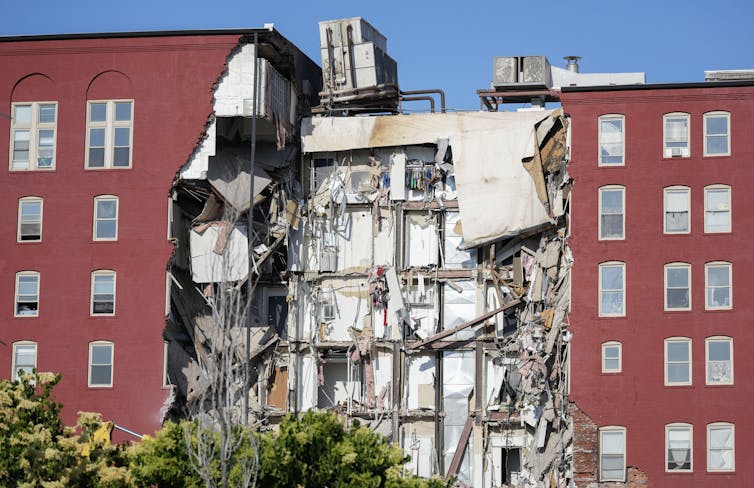
Four recent catastrophic building collapses and a near miss are raising concerns about the state of America’s aging buildings and questions about who, if anyone, is checking their safety.

Many cities have buildings showing signs of aging and in need of repair. In New York City, where a seven-story apartment building partially collapsed in December 2023, the median building age is about 90 years, and many neighborhoods were built before 1900.

As a civil engineer, I study building failures, and I have seen how crucial structural inspections and careful maintenance are – and how often the signs of trouble are ignored in the U.S. until a problem becomes a crisis. Too often, it is up to residents to call attention to the risks.

A video from 2020 shows moisture stains and evidence of failed repairs at the bottom of the basement level parking garage slab in Champlain Towers South condominium before it collapsed. Fiorella Terenzi.