By Will Collette
Time: Sat Feb 03 5:34 PM, Visible: 7 min,
Max Height: 60°, Appears: 10° above WNW, Disappears: 10° above SE
Time: Sat Feb 03 5:34 PM, Visible: 7 min,
Max Height: 60°, Appears: 10° above WNW, Disappears: 10° above SE
Time: Sat Feb 03 5:34 PM, Visible: 7 min,
Max Height: 60°, Appears: 10° above WNW, Disappears: 10° above SE
Time: Sat Feb 03 5:34 PM, Visible: 7 min,
Max Height: 60°, Appears: 10° above WNW, Disappears: 10° above SE

Some Republicans are saying we need to wall off the 5,500 mile Canadian border, too.
In the 1980s, many Texans were alarmed that hordes of
immigrants were fleeing Rust Belt states and pouring across the Red River to
take our jobs. So my friend Steve Fromholz recommended a big beautiful wall
across our northern border to keep them
out.
They must be stopped!
Fromholz, a popular singer-songwriter and renowned
political sprite, was ahead of his time in the political sport of wall
building.
Instead of steel barriers and miles of nasty razor wire,
Steve proposed preventing Yankee refugees from entering the Lone Star State by
planting a 10-foot high, 10-foot thick wall of jalapeƱo peppers along the
length of the Red River. Eat your way through and you’d be accepted as a
naturalized Texan.
I thought of Steve’s impishness when I read that Nikki
Haley, Ron DeSantis, and other Republicans were concocting a whole new
xenophobic bugaboo to goose up their anti-immigrant demagoguery.
How hummingbirds switch mental gears in flight
Hummingbirds use two distinct sensory strategies to control their flight, depending on whether they’re hovering or in forward motion, according to new research by University of British Columbia (UBC) zoologists.
“When in forward fight, hummingbirds rely on what we call
an ‘internal forward model’—almost an ingrained, intuitive autopilot—to gauge
speed,” says Dr. Vikram B. Baliga, lead author of a new study on hummingbird
locomotion published in Proceedings of the Royal Society B. “There’s just too
much information coming in to rely directly on every visual cue from your
surroundings.”
“But when hovering or dealing with cues that might
require a change in altitude, we found they rely much more on real-time, direct
visual feedback from their environment.”
"While the birds did change velocity or stop
altogether depending on the patterns, there wasn’t a neat correlation.”
The findings not only provide insights on how the tiny,
agile birds perceive the world during transitions in flight, but could inform
the programming of onboard navigation for next generation autonomous flying and
hovering vehicles.
Heavy metal exposure linked to problems for middle-aged women
Women with higher exposure to heavy metals may have fewer eggs in their ovaries as they near menopause compared to others the same age, a condition linked to hot flashes, weak bones, heart disease, and other health problems, according to a new study in more than 500 middle-aged women.
Exposures to cadmium, arsenic, and mercury, in
particular, were linked to lower levels of a hormone that strongly correlates
with the number of eggs left in a woman’s ovaries, according to the study, which was
published Jan. 25 in The Journal of Clinical Endocrinology &
Metabolism.
Rock and a hard place for sleep apnea sufferers
By Liz Moughon for ProPublica
Philips Respironics received thousands of complaints about a dangerous defect in its breathing machines but kept them secret for years as stock prices soared. The devices, including the popular DreamStation for sleep apnea, went to children, the elderly and veterans before the global giant announced a massive recall.
In 2021, Philips Respironics recalled its DreamStation breathing machines, along with other sleep apnea devices and ventilators, leaving millions of customers worldwide waiting for replacements. Foam inside the machines could crumble in heat and humidity, sending potentially carcinogenic materials into the lungs of patients.
I spent eight months making a film about this, following sleep apnea patients through airports to doctor appointments. I recorded their home lives, their bedtime routines. I tried to capture the claustrophobic details of the mask that fits tightly over the nose and mouth.
Hundreds of Millions of Dollars for Mitigation Can Ease Offshore Wind Opponents’ Pain
By Mary Lhowe / ecoRI News
contributor
Opponents of offshore wind offer different reasons for their position: fear of impacts on the marine ecology; fear of loss of income for fishers; fear of loss of tourism dollars and private property values due to the sight of the turbines on the horizon.
The cloudy threat of wind projects off the New England
coast comes with a golden — not silver — lining. That gold would arrive in the
form of millions of dollars contractually promised to communities by developers
in the form of mitigations, sometimes through a mechanism called host community
or good neighbor agreements.
Even the towns and historic property owners who dread
wind farms but yearn for funds to do worthy projects could be excused for
reacting to mitigation deals in similar fashion to the character Gaz in the
movie “The Full Monty.” Watching men audition for a new amateur dance troupe,
Gaz observes the impressive talents of one particular auditioner, and mutters,
“Gentlemen, the lunchbox has landed.”
A brief tally of the “lunchbox” of mitigations — touching
on communities and institutions from Long Island, N.Y., to Cape Cod to
Nantucket to Portsmouth, R.I. — shows a total of about $282 million in
negotiated mitigation payments from 2017 to this month. (see below for
details).
A few notable opponents of offshore wind are not looking
for money. Just the past year, Rhode Island entities have filed at least three
civil lawsuits against the state and federal governments over the wind farms,
objecting to what they call rushed, biased, and improper permitting processes.
A fourth lawsuit, with a long list of plaintiffs that includes a national wind
opposition group, was filed Jan. 19.
Green Oceans, a Little Compton-based citizens group, filed a civil suit in the Rhode Island courts in June 2023 against the Coastal Resources Management Council, claiming the permitting process was flawed and asking for a permission granted by CRMC to be rescinded.
Similarly, the
Preservation Society of Newport County and the Southeast Lighthouse Foundation
on Block Island sued the federal Bureau of Ocean Energy Management (BOEM) in
November, claiming the entire permitting process for the South Fork and Revolution
Wind projects was done wrongly and should be re-done.
Study offers rare long-term analysis of techniques for creating standing dead trees for wildlife habitat
Steve Lundeberg
Ecologists
have long known that standing dead trees, commonly referred to as snags, are an
important habitat element for forest dwellers and act as a driver of
biodiversity.
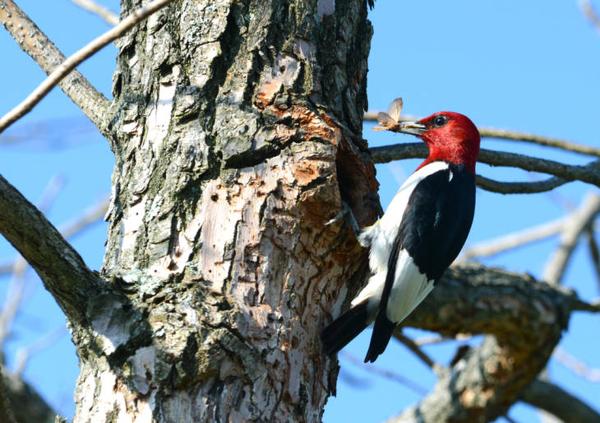
Joe Kosack CC BY-NC-ND 4.0
They’re
so important that in some managed forests, snag creation is part of the
conservation tool kit – i.e., crews sometimes convert a percentage of live
trees into dead ones through techniques ranging from sawing off their tops to
wounding their trunks to injecting them with disease-causing fungi.
Until
now, however, key questions had remained unanswered: How well do any of those
techniques actually work over the long term? And which ones are cost-effective
for land managers seeking to enhance habitat?
Understanding how may lead to new avenues for weight loss
Zachary Knight, University of California, San Francisco
![]() |
| A team of scientists uncovers a logic the brainstem uses to control how fast and how much we eat. Klaus Vedfelt/Getty Images |
As we begin to feel full, we slow down how quickly we eat. For decades, scientists have thought that this change in pace was driven solely by signals from the stomach and intestines to the brain.
But a new study from my lab at UC San Francisco shows that, in fact, there is another process at work, and it begins as soon as we taste our food.
This process has remained unknown until now because we haven’t been able to observe the relevant brain activity in an animal while it was eating. The neurons involved are deep in the brainstem. A graduate student in my lab, Truong Ly, developed new techniques that allowed us to see the activity of these neurons for the first time, in mice.
We discovered that there are two parallel pathways that control our eating – one that restrains how fast you eat and another that limits how much. The taste of food activates the first pathway. This may seem counterintuitive: We usually want to eat more of food that tastes good. But although we may not be consciously aware of it, the sensation of taste also paces our eating.
"Free, free, free?" No, no, no
by Justin Elliott and Paul Kiel for ProPublica
The Federal Trade Commission has ordered the maker of TurboTax to stop what it called years of widespread deceptive advertising for “free” tax-filing software.
The order, released Monday, was accompanied by a 93-page opinion that harshly criticized Intuit, the Silicon Valley company behind TurboTax. Intuit’s “deceptive ad campaign has been sufficiently broad, enduring, and willful to support the need for a cease-and-desist order,” the commission’s opinion stated.
The order caps off a process that started four years ago when the FTC launched an investigation in response to a series of ProPublica stories documenting Intuit’s ad tactics.
ProPublica revealed how millions of Americans were lured into paid tax preparation products even though they were eligible to file for free through a government-sponsored program.
Focus on child care, early education, roads and bridges, affordable housing and public transportation
By Nancy Lavin, Rhode Island Current
Rather than a new tax bracket for the top 1% of earners, progressive lawmakers are instead calling for a proposal that would raise taxes on those with more than $1 million in annual income – about 2,134 tax filers in Rhode Island, compared with 5,000 people who would see their income taxes rise if the top 1% of earners were subjected to a higher tax rate, as has been proposed in years past.
Speaking alongside two dozen progressive lawmakers about their “Working Families Agenda” at a State House event Tuesday, Rep. Karen Alzate, a Pawtucket Democrat, and bill sponsor, explained how the estimated $126 million in revenue from a 3% income surtax on millionaires will fund other priorities.
“Remember when I said, ‘How are we going to pay for all of this’” Alzate said. “This money would be appropriated for child care, early education, roads and bridges — remember that — and most importantly, public transportation which is crucial for districts like mine.”
Not to be forgotten from the list that is getting top billing by progressive lawmakers: extending paid family leave, universal free meals for public school students, stronger protections for tenants and reforming the protections granted to police officers facing misconduct charges.